
HAPPY LIFE

WHAT NEWS?
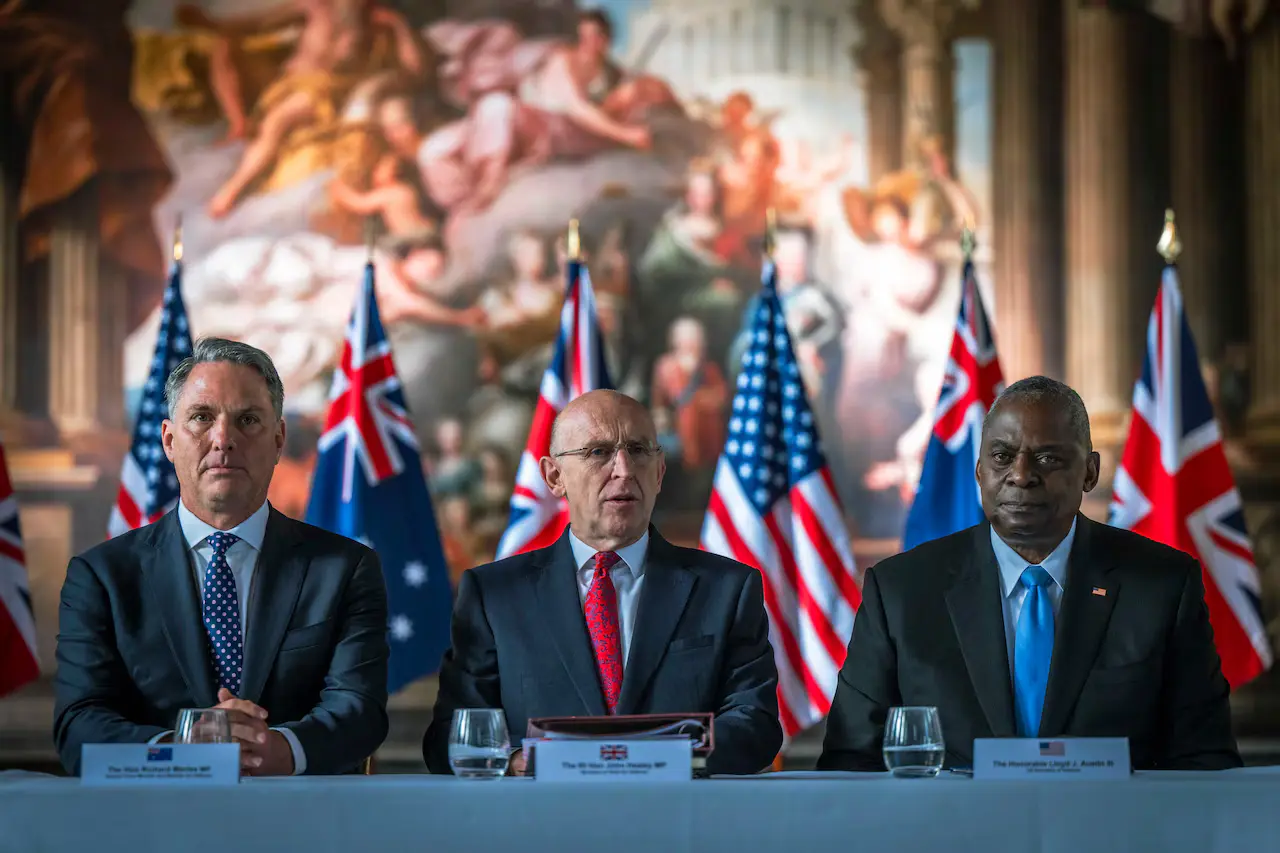
UK Pushes AUKUS Pact from Planning to Delivery After US Review | Os-Intel
UK Pushes AUKUS Pact from Planning to Delivery After US Review | Os-Intel


Trusted News - Expert Analysis - Global Coverage
British officials say the Aukus security partnership must transition from planning to concrete implementation after the U.S. concluded a review of its commitments, urging all partners to accelerate progress in the Indo-Pacific.
he United Kingdom says the Aukus security alliance must shift decisively toward implementation after the United States completed a review of its commitments under the trilateral pact. British officials stressed that the partnership — designed to enhance defense capabilities and counter growing security challenges in the Indo-Pacific — can no longer remain in a planning and consultation phase.
They argued that all three members must now prioritize delivery, particularly on the ambitious submarine program at the heart of the agreement. Aukus, formed by the UK, the U.S., and Australia, aims to supply Canberra with nuclear-powered submarines and expand cooperation on advanced military technologies, including cyber capabilities, quantum systems, and undersea warfare.
But analysts have warned that delays, political debates, and industrial capacity issues risk slowing the pact's progress. Following the completion of Washington's internal review, the UK said the path forward is clearer — and action must follow quickly.

"The focus now needs to be firmly on delivery," British officials said, noting that timely progress is crucial both for regional stability and for maintaining confidence in the alliance itself. The U.S. review examined export controls, industrial readiness, and long-term production commitments.
While Washington reaffirmed its support, the UK emphasized that allied shipyards, budgets, and workforce planning all need to align to keep the project on track. Australia, preparing to integrate nuclear-powered submarines into its navy for the first time, has welcomed renewed momentum but continues to face domestic debates over cost, sovereignty, and timelines.
The submarine program, estimated to cost between $200-300 billion over several decades, represents one of the most complex defense industrial collaborations in history. It requires Australia to develop new nuclear infrastructure, train specialized personnel, and establish maintenance facilities — all while navigating stringent non-proliferation commitments.
Strategists say Aukus is one of the most significant defense shifts in the region in decades — but warn that its success will depend on whether partners can deliver on their promises rather than simply outline intentions. The pact is widely seen as a response to China's expanding military presence in the Indo-Pacific, though officials consistently frame it as enhancing regional stability rather than targeting any specific nation.
"Timelines matter," said a European security analyst based in Singapore. "Every month of delay is perceived as a sign of allied indecision or bureaucratic inertia. Beijing is watching closely whether the West can execute complex, long-term projects in the face of competing domestic priorities."

Beyond submarines, the Aukus "Pillar II" focuses on developing and sharing advanced technologies including artificial intelligence, quantum computing, hypersonic weapons, and electronic warfare systems. These capabilities are seen as critical for maintaining technological edge in an era of great power competition.
The UK's push for accelerated delivery comes amid growing concerns about defense industrial capacity in all three countries. U.S. shipyards are already stretched by domestic naval requirements, while British defense contractors face competing demands from NATO commitments and European security initiatives.
Australia faces perhaps the steepest challenges, needing to establish an entirely new nuclear-powered submarine fleet while managing domestic political divisions. The opposition has questioned costs and timelines, while regional neighbors have expressed concerns about nuclear proliferation risks, despite assurances that the submarines will not carry nuclear weapons.
In the United States, the review's completion clears bureaucratic hurdles but does not eliminate Congressional oversight or funding debates. Some lawmakers have questioned whether sharing sensitive nuclear propulsion technology with Australia could compromise U.S. technological advantages or strain already tight defense budgets.
The UK, positioning itself as a "tier-one" security partner in the Indo-Pacific post-Brexit, sees Aukus as central to its Global Britain strategy. British officials have emphasized that their submarine design expertise and Rolls-Royce reactor technology give them a pivotal role in the trilateral effort.
"We bring decades of operational experience with nuclear submarines and a commitment to see this through," said a UK industry executive involved in the program. "But all three nations need to synchronize their industrial planning, workforce development, and regulatory frameworks."
As the partnership enters what London calls the "delivery phase," attention will shift to concrete milestones: design finalization, construction starts, crew training programs, and infrastructure development. How quickly these milestones are achieved will test not only technical capabilities but also the political will and bureaucratic efficiency of all three democracies.
The success or failure of Aukus will have far-reaching implications beyond the three member nations. Other countries in the Indo-Pacific are watching closely to assess:
As geopolitical tensions continue to shape the 21st-century security landscape, Aukus represents both an ambitious vision of allied cooperation and a practical test of whether democracies can successfully coordinate complex, multi-decade defense initiatives in an increasingly competitive world.